Published on Transitions.org as part of my internship in Prague in Fall 2024. Link to original article.
A week after arriving in Prague after fleeing her home in Ukraine, Tetiana Viter went to a regional assistance center to get a visa. During her 25-hour wait in line to get the visa, Viter noticed there were only Czech psychologists at the center. Having worked as a psychologist in Ukraine since 2012, Viter knew she could use her experience to become the Ukrainian psychologist the refugees needed.
“It’s just that psychology is my field, here I’m like a fish in water,” Viter says smiling, as she welcomes a visitor to her office in the Czech city of Plzen. Using her passion for psychology and helping others, 40-year-old Viter has created spaces here for Ukrainian women to connect.
With a shortage of psychologists and other health professionals in a country that houses the most Ukrainian refugees per capita (about 380,000 are currently registered), Viter’s outreach to fellow refugees is very welcome. A poll of 1,200 refugees in the first year of the war found that 42 percent had symptoms of moderate to severe depression – five times higher than the general population, according to a report co-authored by the Czech National Institute of Mental Health. Just 3 percent of the refugees had sought professional advice for their mental health issues, while 38 percent thought they could be helped by experts.
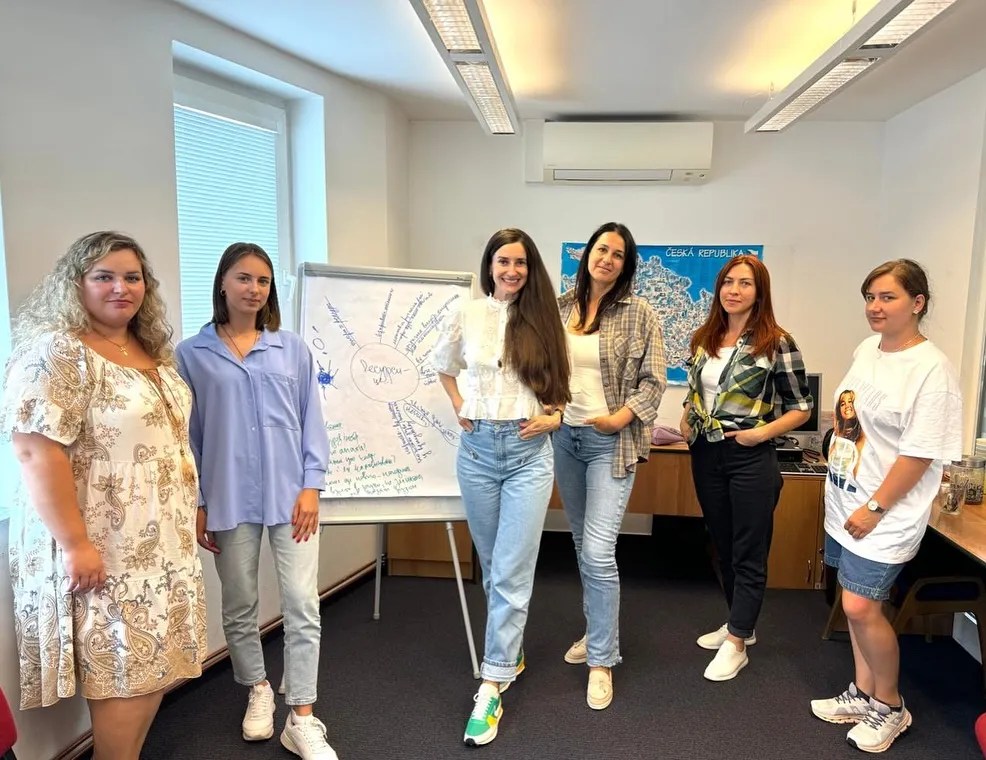
The late afternoon sun paints the room a golden hue. A dozen chairs make a semicircle around the room. Viter pulls a black folding chair along the carpeted floor to the center of the room and sits down. The upper half of a bell tower peeks through the furthest of four large windows. Hand-cut paper slips are taped to the transparent wall next to the door, each displaying a different Ukrainian phrase. A vase of sunflowers sits on a table, alongside an easel with a large white piece of paper covered with writing, likely from an activity done in a therapy session earlier in the day.

A meeting at the Wind of Change Club that focused on building self-confidence. Photo via Tetiana Viter.
Viter holds group therapy once a week here. These sessions create a space where Ukrainians – almost all of them women – can connect, talk, cry, let out emotions, and receive psychological help.
“It’s very good in a group therapy setup that they kind of create their own community and have support just from things that they can experience altogether,” says Amanda Mataija, CEO of Prague Integration, a company that provides mental health support to foreigners living in the Czech Republic.
A Quick Decision
The airfield in Viter’s hometown of Lutsk was bombed on 24 February 2022, the first day of the Russian invasion. At home less than two kilometers away, Viter woke up that day to the sound of explosions.
“With each subsequent explosion, I was afraid that a rocket would fly into our house,” she says. “It was very scary.”
Three days later, Viter and her then 12-year-old son fled their home. She decided to seek refuge in the Czech Republic, where her sister had worked as an engineer for several years.
The shock of forced emigration had a “very negative impact” on her, Viter says. “But as soon as I started doing what I do best and became a volunteer at a crisis center, I helped myself by helping others.”
She worked as a volunteer psychologist during the first six months of her stay. She then worked as a staff psychologist at several charitable organizations before finding her current position at Ledovec, a nonprofit in Plzen that offers a range of services to people with, or recovering from, serious mental health issues, from psychological and psychiatric care to help finding a job or housing.
Wind of Change
While there are other Ukrainian psychologists in the Czech Republic, Viter says there are not many. She used to work on a hotline for refugees needing support, but the line was closed in May 2023 because of a lack of funding. Now Viter provides support to fellow Ukrainians in three main ways: individual consultations, group therapy sessions, and running the Wind of Change club.
Viter (her name means “wind” in Ukrainian) founded Wind of Change after she began working with fellow refugees. The group meets weekly to focus on positivity in the face of hardship. Viter facilitates activities for the group. In the summer of 2023 she took the group hiking in the mountains of the Czech Republic and Germany. They spent a night in the forest watching shooting stars. “It was incredible,” she reminisces.
The majority of the people in Viter’s group sessions and club meetings are women. This is because four in five Ukrainian refugees in the Czech Republic are women and children, similar to other EU countries that have taken in refugees. Most men are prohibited from leaving Ukraine to stay and assist with war efforts.
The strong Czech economy has long been a magnet for Ukrainian workers, mainly in low paying jobs such as construction and house cleaning. The war has only reinforced that pattern: currently at 2.7 percent, the unemployment rate is the lowest in the EU, and Ukrainian refugees play a key role in helping to fill job vacancies.
However, despite being employed, these positions are often lower-status jobs than the refugees had in Ukraine. Half of the Ukrainian refugees in Czechia are working in low-paid, unskilled jobs and two-thirds are working below their qualification level, according to a 2023 report from the European Commission.
“That is, for sure, kind of a hit on their ego, for both personal achievement and on the financial side for a mother that has two children,” says Mataija from Prague Integration. She gives three reasons why Ukrainian women struggle to find work that fits their qualifications: language barriers, delays with the recognition of their diplomas, and the need to find time to care for their children.
Underpaid and Overqualified
As a result of these obstacles, two-thirds of Ukrainian refugees are living below the poverty line, says the 2023 EC report. The economic barriers in Czechia have forced many Ukrainians to return home, says Petra Ezzeddine, a social anthropologist and assistant professor at Charles University in Prague. Ezzeddine’s research focuses on gender in migration.
“More women have two or three jobs, even those qualified women because they are sometimes in the situation of being single mothers,” Ezzeddine says. “You need to have another salary to make a living, especially in times of crisis.”
Being forced to take a much less skilled job than the refugee’s prior occupation is upsetting, especially for medical workers. Although the Czech government has eased work rules for nurses and some other categories of skilled workers in sectors hit by labor shortages, stories abound of Ukrainian doctors and other health professionals having to work menial jobs when they arrive in the Czech Republic.
“I know cases when these doctors simply could not stand it and returned to Ukraine,” says Viter.
One former client operated a dental clinic in Lviv before the war. Unable to find a job in her field anywhere in the Czech Republic, the best job she could get was as a saleswoman. The woman ended up returning to Ukraine to continue practicing dentistry.
Next, Viter tells the story of one woman who had to return to Mariupol because the salary from her factory job was not enough to pay for housing. Large swathes of that front-line city in the Donetsk region were leveled by Russian forces, but she had no choice but to go back to afford housing and take care of her two children.
Another refugee whom Viter knows was a production manager in the city of Dnipro, who now washes dishes in a restaurant in Czechia.
Members of the Wind of Change club during an overnight hiking trip. Photo via Tetiana Viter.

“People without a job are also worse off, but also those who work in significantly less skilled jobs than they originally had,” says Martina Kavanova, an analyst with PAQ Research, a nonprofit social research agency, in the 2022 National Institute of Mental Health report. The report also stated that Ukrainians who are forced to work in lower-level jobs are more likely to suffer from symptoms of depression.
Viter feels grateful for the measures that the Czech people have taken to support Ukrainian refugees like herself. While Ukrainians face hardships in Czechia, the country has provided a temporary home for refugees to live safely.
“It’s one thing to experience the war here, being deeply wounded inside, but it’s a completely different thing to be in a country under missile attacks while already so hurt,” Viter says. “That would have been even worse.”
Refugees, like Viter, rarely if ever plan to stay in a new country permanently. “All the refugees have this dream to go back home, they always think it’s temporary,” Ezzeddine says.
Viter may face the difficult decision of whether to stay in the Czech Republic or return home. She says she never envisioned herself going abroad because she loves her country and the life she had there. Going home to a war zone, though, could threaten her and her child’s lives.
“On one hand, I am a mother – I am very worried about my child, about my son,” Viter says. “On the other hand, I love my country very much, and my son loves the country, and I have everything in that country to live there happily ever after.”
Viter tries to not think about the cloudy future, instead focusing on the present moment and how she can support her fellow refugees.
“As long as I live in the moment here and now, I can be useful to Ukraine by supporting refugees,” she says. “Of course not in the way in which men do in Ukraine, or at the front, but I give them strength, support for their inner selves.”

 Emma Kahle
Leave a comment