Originally written for my Intro to Journalism course in November 2022
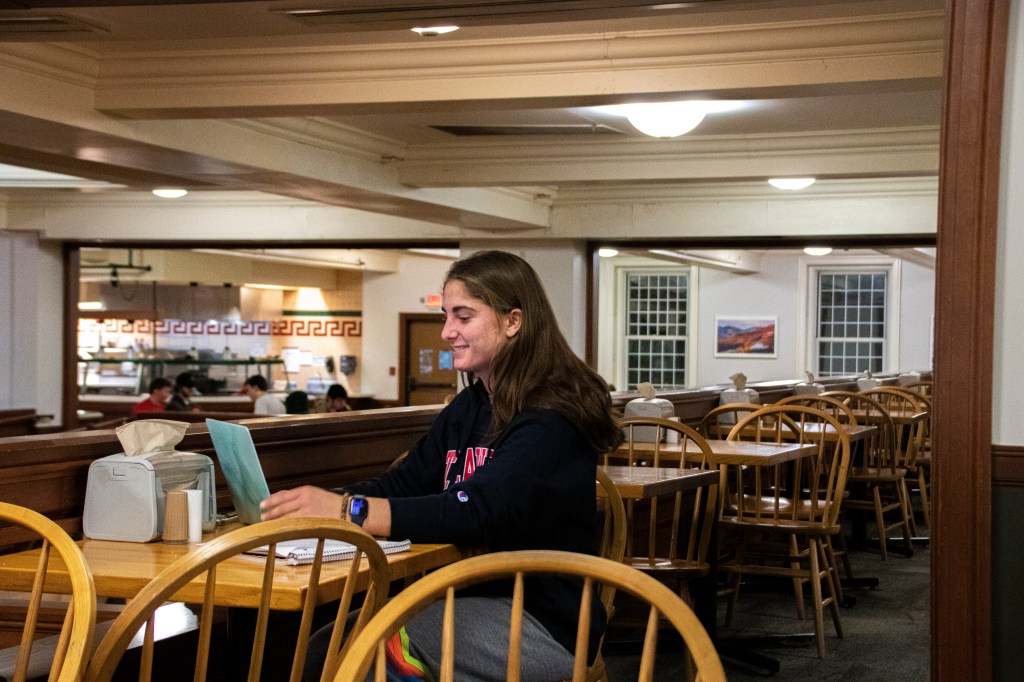
Some students at St. Lawrence, especially first-years, are scared to eat alone at Dana Dining Hall. Where does this fear come from and how can the community work to normalize solo dining?
Dr. Yesim Bayar is a Sociology Professor here at SLU. When discussing how her expertise relates to the topic of eating alone, Professor Bayar referenced a famous sociologist named Erving Goffman, who studies people’s everyday interactions and coined the phenomena known as Impression Management. “Every episode is a performance, so what you do in the classroom, going to Dana, and everybody has a script in their mind,” she explains. “So the script is very much what you want to get out of that social situation, but that script is also formed by cultural norms.”
Laura Lavoie is the director of Wellness Education and Student Engagement at St. Lawrence. She too attributes the fear of eating alone to cultural norms. “In most cultures, eating is viewed as a social activity and eating alone may be seen as taboo,” she states. “So doing so may feel uncomfortable.”
Bella Danza ‘26 admitted she could never see herself going to Dana alone. “If I ever was in an instance where I had to eat alone I would definitely want my computer, even if I had no work,” she adds.
Danza sees the ability to eat alone as “a sense of comfort in your own presence.” She believes it is important to normalize this fear, and hopes to someday find the confidence in herself to go to Dana alone as well.
Student Lilly Stone ‘26 feels comfortable eating alone, but can see how the fear of judgment might prevent her peers from doing the same. “They feel vulnerable,” she says. “And I feel like I kinda get it that it is vulnerable to watch people in groups, and you’re just there alone.”
Similarly to Stone, Owen Purinton ‘26 also feels comfortable eating alone, but can sympathize with the fear felt by his peers. “Maybe just because they are worried about the thoughts of others,” he proposes. “Maybe they don’t wanna be seen as someone who doesn’t have any friends.”
Lavoie expects there is likely a stigma surrounding the act of eating alone at Dana, citing examples outside the SLU bubble that also tend to stigmatize it. “Thinking about the way eating is viewed as a communal activity in so many cultures, and how eating alone is often negatively portrayed in media, particularly films,” she notes. “I can understand why it could feel stigmatized here too.”
Gabrielle Cloutier ‘26 often feels sorry for others when she sees them sitting alone. “I personally feel bad, like I’ll look at them, or if I’m sitting with someone, I’ll point at them and be like ‘aww I feel so bad,’” she admits. “When really, it could’ve been their choice to come there alone, and maybe they just wanted alone time and just wanted to enjoy a meal, but I guess it’s like perspective.”
Lucas Zawko ‘26 often dines solo, but can understand why the stigma can make it harder for others to do the same. “I bet it could [be scary] for certain people with different social anxieties and stuff,” he hypothesizes. “A big crowd of people sitting together could probably look kind of intimidating.”
Cultural stereotypes in one’s childhood often cast a negative shadow over their current beliefs, and Lavoie adds that eating alone is notoriously misrepresented as only being done by people with no friends. To counter this predisposition, she provides numerous examples as to why someone might choose to eat alone: such as reviewing notes for an upcoming test or decompressing from social interactions by listening to music. Neither of these reasons have any correlation to a person’s number of friends, but rather show a mature prioritization of one’s own needs.
Professor Bayar reiterates the importance that upbringing plays in forming the thought patterns that instigate fear in being seen eating alone. “If you ask sociologists, it’s about the sort of the cultural values that you grow up in, and that you internalize, that tend to come out during social situations like that,” she explains.
Students like Sophia Thomas ‘26 agree that these thought patterns from her childhood are largely to blame. “It was so rare, nobody ever ate by themselves,” she recalls. Having these beliefs ingrained in Sophia’s memory perpetuate the fear she experiences towards eating alone at Dana, while also planting assumptions on why they are sitting on their own. “I see people eating alone and I kinda feel bad for them, and I don’t want anyone to feel bad for me because I’m just chilling,” she adds.
Cloutier too agrees that her preconceptions formed during high school have influenced her perception of eating alone. “I think people are gonna think the same patterns as what they thought when they were being raised,” she suggests. “In coming from high school, whatever your high school was like, I think that’s gonna play into how you see other people sitting alone.”
But how does the SLU community reconfigure these misconceptions, especially in its younger students? Lavoie sees communication as conducive for instilling change. “Talking about things—communicating—can go a long way in breaking stigma,” she says. Additionally, Lavoie sees inclusivity as an important tool to help peers who might not actually want to be alone. “Maybe they would love to have someone to sit with,” she proposes. “And in that case, extending an invitation could make a big difference.”


 Emma Kahle
Leave a comment