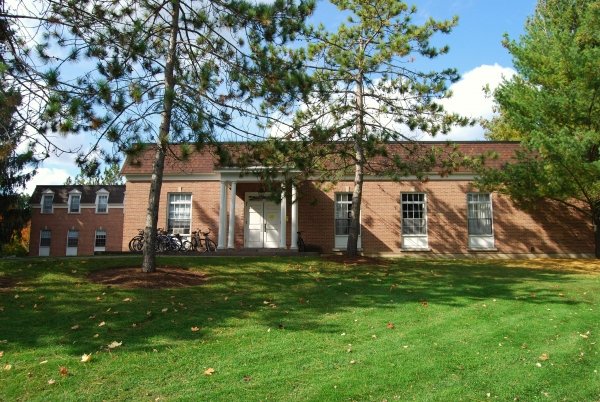
Originally written for my Intro to Journalism course in October 2022
Three first-year residence halls at St. Lawrence University have significantly fewer people and are further from the dorms where most of their peers live. Students in these isolated dorms can form strong friendships with the people they live with, but struggle to connect with students in other dorms. If these same students lived in a bigger dorm, such as Rebert or Lee, would they have an easier time making connections with their peers across campus?
Professor Mark Oakes, who teaches social psychology at St. Lawrence, believes that geography is less important in forming friendships than the natural closeness of communal living. “It’s not just geography, but architectural design can actually influence who is friends through this functional distance,” he says. “Because it [distance from other dorms] has people come in contact with others more based on the way things are designed.”
Closeness helps create connection, but it can also perpetuate feelings of annoyance and frustration. According to Oakes, these smaller dorms help students find the people they enjoy being around. “Now, that also means that when you’re exposed like that, that you find the people that you like,” he states. “And guess what, you also find the people you don’t like.” The juxtaposition between making friendships or forming aversion towards a peer is rooted in mere exposure, or in the high frequency of encounters as a result of living in close proximity to each other.
Though the connections can be positive or negative, these close bonds are often rooted in the location of one’s dorm room. The Self Perception Theory, or how one perceives her own behavior, often facilitates close connections. “I look at the people around me, and I may not necessarily have chosen to be friends with them,” says Oakes. “But because I see them so often, I make an inference to say, hey, well, jeez… I’m around them a lot, I must like them.”
To further explain this phenomena, Oakes brought up a study conducted in 1950 at the Westgate dormitory complexes of MIT. The dorms studied at MIT resemble the bigger first-year dorms at SLU, and Oakes builds on the findings to counter the idea that people in smaller dorms are at a disadvantage in terms of finding friends and forming connections.
The study focused on close friendships, and had residents name their three closest friends in college. The study found that “65 percent of friends named for those three closest ones came from the same building.” This study speaks to the nature of intra-building friendships, regardless of the geography of the campus.
Aside from the overall dorm capacity, Oakes uses the study to reiterate the role that proximity plays in forming friendships in college. He details how the likelihood of two students becoming friends tends to decline in a stepwise fashion as the distance between their dorm rooms gets greater. “And it’s really interesting as the number of doors increases away from you,” he says. “The number of friends that were mentioned in these three closest steps down from 41 to 20 to 16 and 10.” The steep decline in these percent values further supports Oakes’ theory that a dorm’s geographic isolation does not directly correlate to feelings of social isolation of its residents.
Assistant Professor Andrew Donofrio teaches organizational communication at St. Lawrence. Donofrio connects Maslow’s Hierarchy of Needs to those of first-year students. “How do we encourage a sense of belonging, so that you stay here, you want to be here, and you feel like you’re a part of the community?,” he asks.
Donofrio emphasizes the overarching importance of feeling connected to one’s college. “If you develop a sense of belonging in that first year, that first couple of semesters, you’re more likely to have a higher GPA, and you’re more likely to work your way through the entire degree,” he states. “Meaning you don’t quit school, and you don’t transfer.”
Feeling comfortable and acclimated to college is essential for first-year students to lay the groundwork for successful years to come, according to Donofrio. “Because if I feel isolated, then I don’t feel a sense of belonging,” he adds. “And so the processes of socialization are all about getting you to feel that sense of community.”
Both Donofrio and Oakes concur that being in an isolated dorm aids in creating genuine, more intimate connections with peers. Oakes comments on these tendencies, noting there is “a stronger bond with the people that they’re around, because there’s going to be fewer of them” in conjunction with the conversation on how isolation affects connection between first-years.
Gabrielle Aldrich is a junior, but lived in Reiff her first year at SLU. Her enthusiasm and obvious pride in her dorm reiterate the positive experience she had. “Like you know, whenever I hear someone’s from Reiff, I’m always like oh, Reiff is Life,” Aldrich says. “And I have this instant connection with them.”
Gaines resident Trey Pierce points out the camaraderie and closeness that inevitably arise from living in an isolated setting. “Everyone in Gaines is nice,” he notes. “And I think a lot of people will be really, really close friends who they live with because you’re so isolated.”
Molly McNally, another Gaines resident, feels envious of how convenient it is for students in bigger dorms to connect with new people. “But it’s definitely been harder for me to make friends outside of Gaines,” she admits. “because I don’t really know anybody.”
Convenience is highly relevant in grasping the grievances of those living in the further dorms. Oakes understands the costs of interaction in connection to isolated students, as they need to travel more distance to meet people outside of their dorm. “They have to expend energy to do that,” he says. “And one of the reasons why we are more friends with people around us is because it doesn’t take the energy.”
Aldrich also acknowledges the limitations of being in a smaller, more isolated dorm. “And that’s your only social circle, or at least like your main social circle,” she says. Cliques and drama were also perpetuated by the small dorm community, and Gabrielle recalls that “it was really hard to reach out to other dorms.”

 Emma Kahle
Leave a comment