Written for my bi-weekly column “An Occasional Word” in The St. Lawrence Plaindealer, a printed newspaper serving the Canton, New York Community.
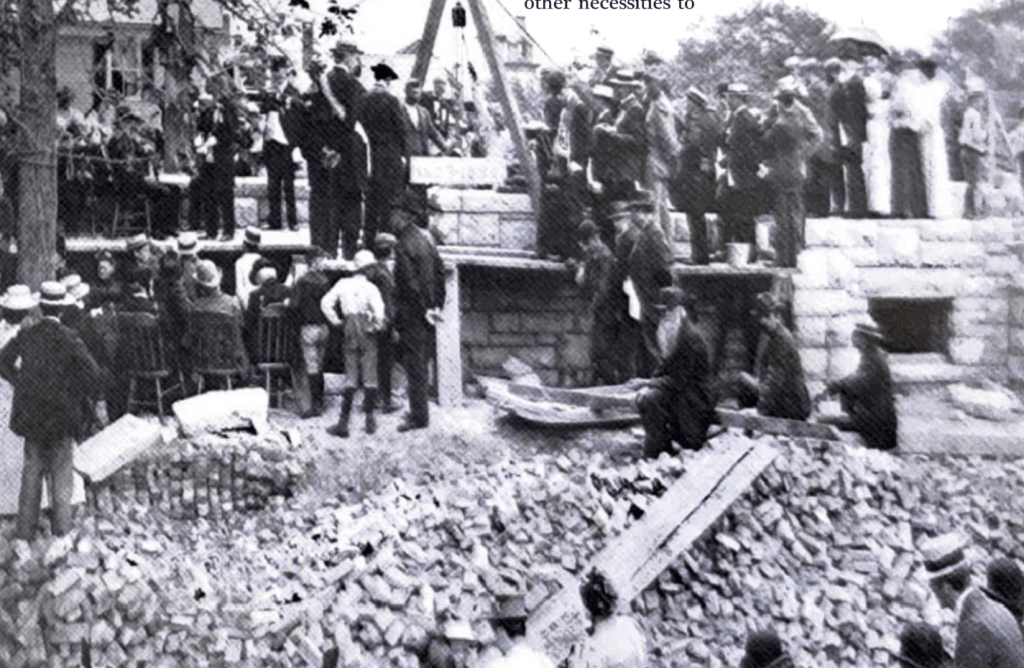
St. Lawrence University was founded by the Canton Universalist Church, a religious community celebrating its bicentennial this year. I was surprised to learn about the 1856 founding tale, because I feel like the biggest SLU fan. How could I have no clue about who founded the college that has given so much to me the past three years? But after asking around I realized I am not the only one unaware of important St. Lawrence heritage. I fear that the administration’s emphasis on being non-denominational might have inadvertently buried its early Universalist history.
Universalism, whose core principle is universal salvation, spread to St. Lawrence County from New England, with the First Universalist Society of Canton established on November 17, 1825. The church founded St. Lawrence in 1856 as a theological school, a seminary focused on preparing students for futures in Universalist ministry or other religious careers. A later College of Letters and Science, meant to give seminary students general knowledge, mirrors the liberal arts education offered by SLU in the 21st century.
In 1961, the Universalists and Unitarians merged to form the Unitarian Universalist (UU) Church. The UU Church on Main Street has served a pivotal role connecting Canton and St. Lawrence.
Peter Beekman grew up Catholic; he moved to Canton in 1989 to work at SLU. After having their first child, the Beekmans decided to explore a religious experience that was not as doctrine- and creed-driven as Catholicism. They joined Canton’s Unitarian Universalist Church in 1994.
Beekman remembers being struck by how the congregation encouraged young children to just be themselves. While Catholic Churches would force a mother and her crying baby to leave the service, the UU Church did not.
“I found that very attractive, and the religious education was very value-based, welcoming everyone,” recalls Beekman. ““That was how we wanted our kids to be brought up.”
Beekman is also proud of the strides the UU Church has made toward being more welcoming and inclusive, regardless of gender identity or sexuality. As a liberal, religious community, the UU Church continues to combat social issues: women’s suffrage, anti-war protests during Vietnam, and LGBTQ+ rights. The church participates in the Canton Church and Community Program, a charity that works with other local churches to provide food, clothing, and other necessities to those in need. Beekman believes the church’s desire to help others is “embedded in our DNA.”
St. Lawrence’s immediate past president William Fox grew up attending the Universalist National Memorial Church in Washington, D.C. hearing about St. Lawrence from his minister, St. Lawrence University and Theological School graduate Seth Brooks. One thing led to another, and
Fox was appointed the 18th president of St. Lawrence in 2009.
Despite focusing on academic endeavors, Fox stayed connected with the Universalist Church. “I enjoyed attending morning worship at the Canton church whenever I could and always appreciated the occasional opportunity to speak from its pulpit,” says Fox.
Fox reiterates the importance of St. Lawrence’s Universalist founding. He argues that many of SLU’s values are drawn from its Universalist roots: dignity of the individual, openness to differences, mixing of scholarly disciplines, the trustworthiness of empirical/scientific study, and the ambition to serve one’s community.
“It is no accident that current interests on campus about caring for people in need, the quality of our environment, and the essence of democratic institutions are traceable to St. Lawrence’s Universalist heritage,” says Fox.
Beekman echoes the importance of informing SLU students about the founding of their institution. “Our history is your history, and I think there should be recognition of that, or at least an understanding of it,” he says.
Being unaware of the college’s history is far from a new phenomenon for SLU students. In an October 1952 letter to alumnus and Plaindealer editor Atwood Manley, Trustees Chair Owen D. Young expressed frustration over an encounter he had with a current student.
“I was indeed shocked this summer when a young lady who is now a senior visited us and I discovered that she knew almost nothing about the background of the college and of the Universalists who had made it.” Students need to realize, he continued, “the stimulating power of Universalism as a factor in the founding and development of the institution.”
“I cannot think of a single historical instance when the Canton UU Church and St. Lawrence University were not in accord with each other on the big questions of life – each organization standing to support the individual’s freedom to explore a life of the mind and the human spirit within a respectful and caring community,” says Wolf.
Note: I consulted material in the St. Lawrence University Special Collections in writing this article.



 Emma Kahle
Leave a comment